THE NEW EDUCATIONAL SEASON
1. “Drawing new maps of hope”
At the end of October and the beginning of November 2025, the Jubilee of the Educational World was celebrated in Rome, having as its theme “Constellations of Hope.” This event, organized by the Dicastery for Culture and Education, brought together thousands of educators who participated in the various events of the educational Jubilee week. On that occasion, Pope Leo XIV inaugurated a new season for Catholic education, offering guidelines for the coming years.
As is well known, the Catholic Church is today one of the largest educational institutions in the world, with over 238,000 schools, 1,300 Catholic universities, and 400 ecclesiastical faculties. This huge pedagogical heritage embodies the Church's conviction that education is a privileged means of promoting justice, peace, and fraternity.
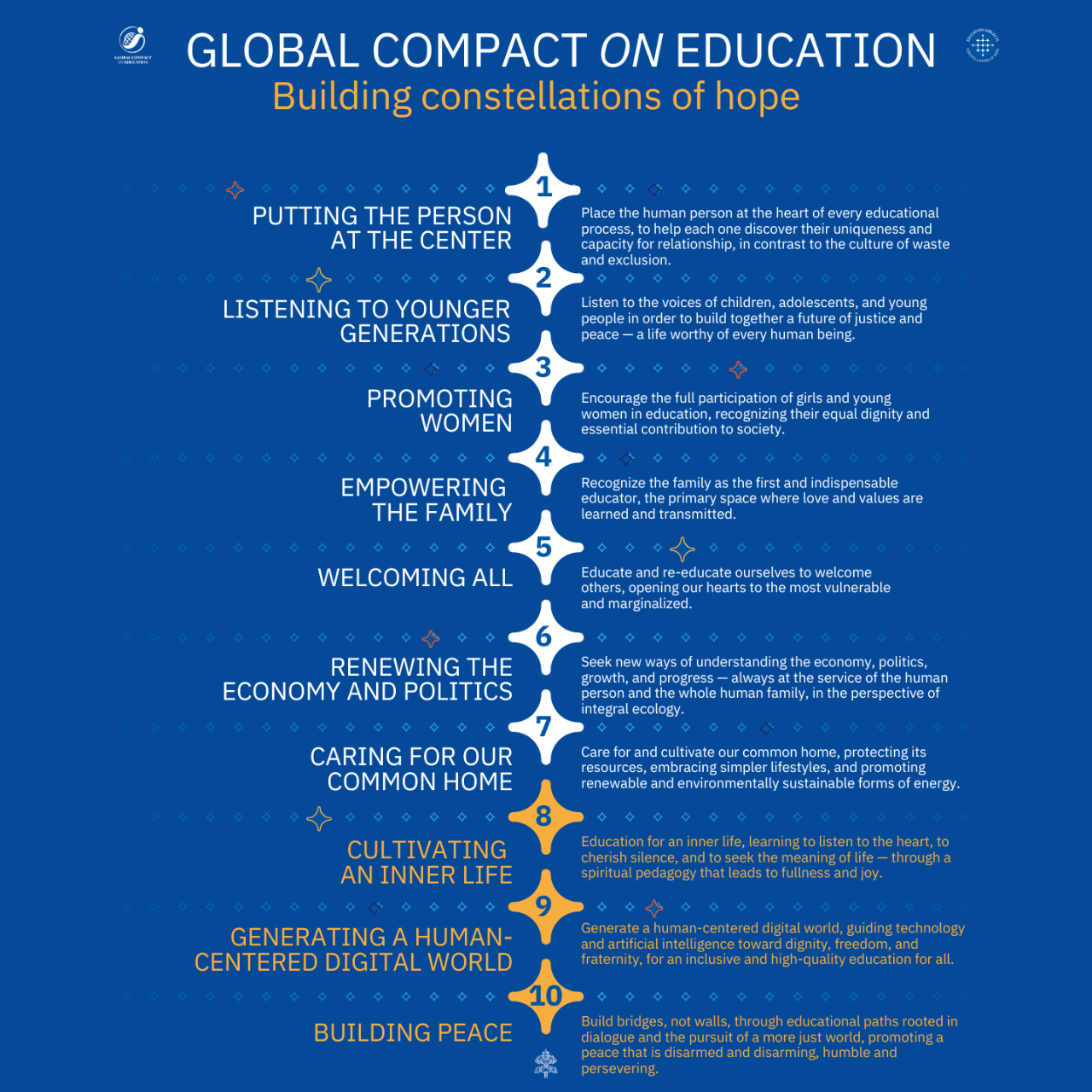
Pope Leo wanted to take up and relaunch the great educational legacy left by Pope Francis, expressed in hundreds of speeches and above all in the Global Educational Compact project, based on seven major aims: the centrality of the person, young people, women, and the family; attention to the poor; and the renewal of politics, economics, and ecology.
Now, Pope Leo XIV, with his Apostolic Letter “Drawing New Maps of Hope” and with his speeches during the Jubilee, reaffirms the fundamental principles of Gravissimum Educationis and further develops the legacy of the Global Educational Compact, introducing three new and deeply relevant objectives that complete the “Decalogue of Catholic Education” for the coming years.
2. Global Educational Pact 2.0: The Decalogue of Catholic Education
I. Cultivating an inner life
The Committee for the Global Educational Compact conducted interviews with young people from around the world during World Youth Day and the recent Youth Jubilee. When asked, “What do you dream of for education in the future?” the majority replied – to our amazement – “Help us to educate the interior life.”
The Pope, speaking to students gathered in the Paul VIth Hall during the Jubilee of the World of Education, said:
“Dear young people, you yourselves proposed the first of the new challenges that call for our commitment in the Global Compact on Education, expressing a strong and clear desire; you said: ‘Help us in the education of the interior life.’ I was truly struck by this request. Having a great deal of knowledge is not enough if we do not know who we are and what the meaning of life is. Without silence, without listening, without prayer, even the light of the stars go out.”
We live in a hyper stimulated and fast-paced society, which often leaves no room for listening to oneself. Many forms of discomfort—anxiety, aggression, isolation, addictions—are rooted in an unrecognized inner emptiness.
Education of the interior life means educating for hope. It means helping every young person to discover a centre, a meaning, a voice that dwells within them; it means teaching that every life, even a wounded one, is capable of light.
Catholic universities nowadays are called to be places where we may learn once again to “see the stars”: to combine research and depth, science and meaning, knowledge and wisdom.
II. Generating a human-centered digital world
The second new aim concerns the great challenge of the digital world. The Pope said:
“The second of the new educational challenges is a commitment that affects us every day and in which you are teachers: digital education. (...) But, do not let the algorithm write your story! Be the authors yourselves; use technology wisely, but do not let technology use you. Artificial intelligence is also a great novelty – one of the rerum novarum, or ‘new things’, of our time. However, it is not enough to be “intelligent” in virtual reality; we must also treat one another humaely, nurturing emotional, spiritual, social, and ecological intelligence. Threfore, I say to you: learn to humanize the digital, building ita s a space of fraternity and creativity – not a cage where you lock yourselves in, not an addiction or escape. Instead of being tourists on the web, be prophets in the digital world!”
We live surrounded by digital technology: it is an extraordinary opportunity for knowledge and communication. However, we must be careful that technology does not become a cage, a place of addiction or isolation.
Education for a digital humanization means: teaching critical and responsible use of the media; nurturing empathy, emotional and spiritual intelligence; creating a digital environment that is a place of encounter, not hostility; and raising citizens capable of living with technology without being dominated by it.
For this reason, Pope Leo invites young people not to be “tourists of the web,” but “prophets in the digital world”: not passive consumers, but creators of meaning and fraternity.
III. Building peace: an unarmed and disarming peace
The third aim concerns peacebuilding. The Pope said:
“You can see how much our future is threatened by war and hatred, which divide people. Can this future be changed? Certainly! How? With an education for peace that is disarmed and disarming. It is not enough, in fact, to silence weapons: we must disarm hearts, renouncing all violence and vulgarity. In this way, a disarming and disarmed education creates equality and growth for all, recognising the equal dignity of every young person, without ever dividing young people between the privileged few who have access to expensive schools and the many who do not have access to education.”
Peace does not come about overnight. It is a patient art: it consists of listening, dialogue, reconciliation, respect for diversity and non-violent language.
Education for peace means: disarming words, avoiding aggression, vulgarity and polarisation; disarming the heart, healing grudges, prejudices and hostility; and disarming education, transforming schools and universities into spaces for constructive discussion, not sterile competition.
The Holy Father invites us to be peacemakers first and foremost in our everyday lives: the family, school, sport, friendship.
Conclusion – Building constellations of hope
Every school and university is like a star in the great constellation of global education. Each has its own light and contributes to illuminating the future of humanity. If a star stands alone, it is just a point in the universe. If there are other stars nearby, it forms a constellation.
We live under the same sky, animated by the same search for truth, sustained by the same hope.
The task of education is, today more than ever, an act of courage and a work of light.
Educational and academic institutions continue to be living stars in this firmament, helping young people to discover who they are, what meaning their lives have, and what unique contribution they can offer to the world.
At the end of the Jubilee of the World of Education, Pope Leo proclaimed St John Henry Newman a new Doctor of the Church and co-patron of education: may St John Henry bless our students and accompany all our educators in this new educational season, to carry out with enthusiasm the most beautiful mission of all, educating the younger generations.