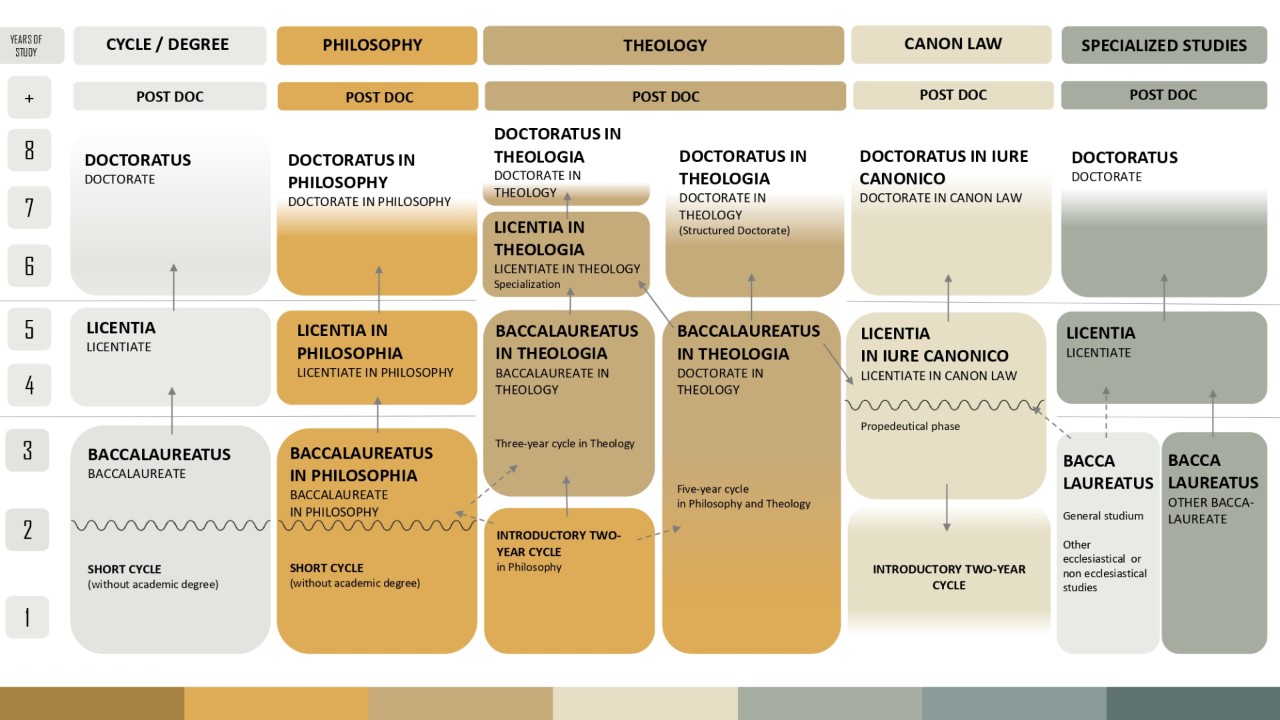
In our case, the Holy See, through the Dicastery, is the National authority which has the responsibility for ecclesiastical studies and corresponding qualifications.
Through the NQF, all degrees that are comparable or compatible with degrees issued by other higher education systems are listed. This instrument also provides indications regarding the presentation and drafting of curricula (that are general in scope in relation to the different study areas), applying ECTS (to refer to study duration and student workload) and so called “learning outcomes” to express the skills achieved by a “typical” student at the end of his/her academic career.
The NQF is structured as a graphical map displaying the entire System of Higher Ecclesiastical Studies, including and presenting the courses that are offered by Institutions erected or approved by the Dicastery, in a way that is transparent and comparable (to other education systems). Therefore, skills and professional profiles are presented, in relation to possible operational activities and jobs, in order to contribute to building a global reference system that includes degrees awarded in countries, which have signed agreements with the Holy See.
The Holy See’s NQF is part of a broader qualification context which aims to unify the criteria and language of courses supply in (national) higher education systems at regional, continental, and – hopefully, some day – global level.
The Qualification Framework of the Holy See is characterized by three aspects:
- It includes only Higher Education (it is a Qualification framework, that is organized according to the three cycles defined by the Bologna Process, therefore following the EHEA-NQF structure).
- It is sectoral (it includes only a few subject-matters which make up the Holy See’s Education System).
- It is global (it applies to the Holy See’s academic institutions worldwide).