
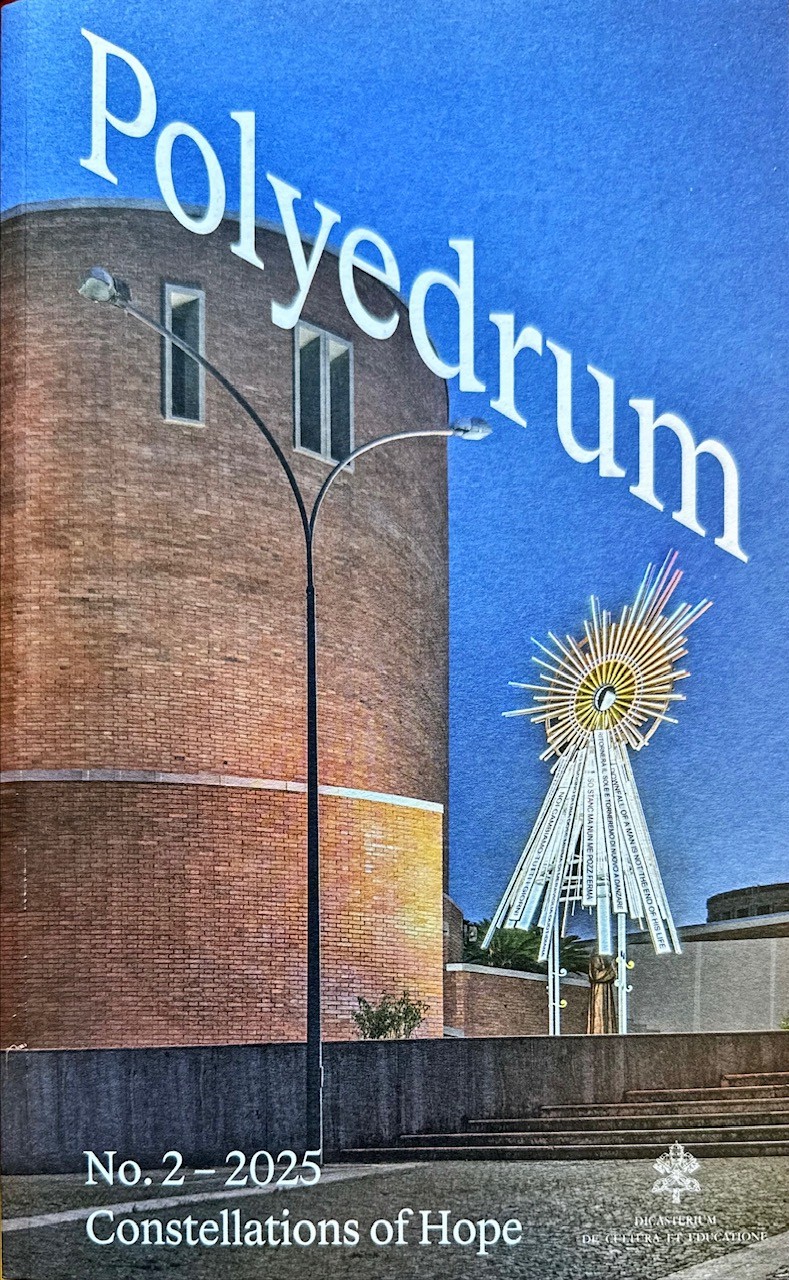
From 2024, the Dicastery for Culture and Education will publish the journal POLYEDRUM: Cultura et Educatio, the Dicastery’s official publication.
POLYEDRUM brings together and revitalises in a profoundly renewed way the legacy of the journals Educatio Catholica and Culture and Faith, which were respectively the official publications of the Congregation for Catholic Education and the Pontifical Council for Culture: with the Apostolic Constitution Praedicate Evangelium, dated 19 March 2022, the Holy Father merged the two dicasteries into the new Dicastery for Culture and Education.
The title, POLYEDRUM, indicates the adoption of the approach to reality advocated by Pope Francis since the beginning of his pontificate: “The model is not the sphere, which is not superior to its parts, where every point is equidistant from the centre and there are no differences between one point and another. The model is the polyhedron, which reflects the convergence of all the parts that retain their originality within it” (Evangelii gaudium 236). The journal, in fact, approaches the topics covered from multiple angles, thanks to the diversity of approaches offered by the various disciplines and arts brought together.
The frequency of publication of POLYEDRUM is annual. The journal is published as a monographic issue and presents a collection of the best essays on a specific topic, selected by an international editorial board and published over the last two years in the journals of the Catholic schools, Catholic universities, faculties of theology and cultural centres that make up the Holy See’s extraordinary international educational and cultural network.
The purpose is to recognise, promote and disseminate excellence wherever it manifests itself: in places considered ‘central’ and in those regarded as ‘peripheral’. In doing so, the aim is to respond to Pope Francis’ call regarding the “urgency” of “networking” among the Church’s various educational and cultural institutions (Veritatis gaudium, Introduction 4 d).
The topic of the first magazine POLYEDRUM is intelligence and the diversity of its forms: Multiple Intelligences. The subject of intelligence is once again taking centre stage in both social and academic circles due to so-called generative artificial intelligence. Interest has intensified since 2022, when the arrival of ChatGPT and other chatbots captured the public imagination, demonstrating the extraordinary speed of technological progress in unlocking the potential of the digital world. The debate has polarised around the potentially threatening consequences of Generative Artificial Intelligence for humanity, or its indispensable contributions to its benefit. A multifaceted approach to the mystery of intelligence is the primary condition for avoiding knee-jerk reactions that breed obsessions and fixations detached from reality, which is – in any case – superior to any abstract idea.
Each issue of Polyedrum will feature the work of a single artist, providing a space for their ideas to be expressed. The artist chosen for this first issue is Portia Zvavahera, an African painter deeply rooted in the ancestral culture of her people. Mirta d’Argenzio introduces her in her visual essay and in the previously unpublished introductory text: “I visited Portia Zvavahera in her studio in Harare, Zimbabwe, where I spent ten days with her, witnessing the creative process behind the latest series of paintings she conceived and produced, intended to illustrate our project on intelligence. In her case, intelligence expressed through the making of art and the practice of her painting. My curatorial choice was shared with the artist, who decided to make available for this project some of her most significant works, previously unpublished. She allowed me to delve into them with her. Together with Portia, I selected and constructed the sequence of works that helped me to relate them to one another, revealing to me, during the days spent in the studio, her most intimate and secret fears, linked to the development of the painting and the creation of certain recurring images that have accompanied her for years, mostly linked to her dreams. Personal dreams, which are images of thought, involuntary narratives that speak of us."