

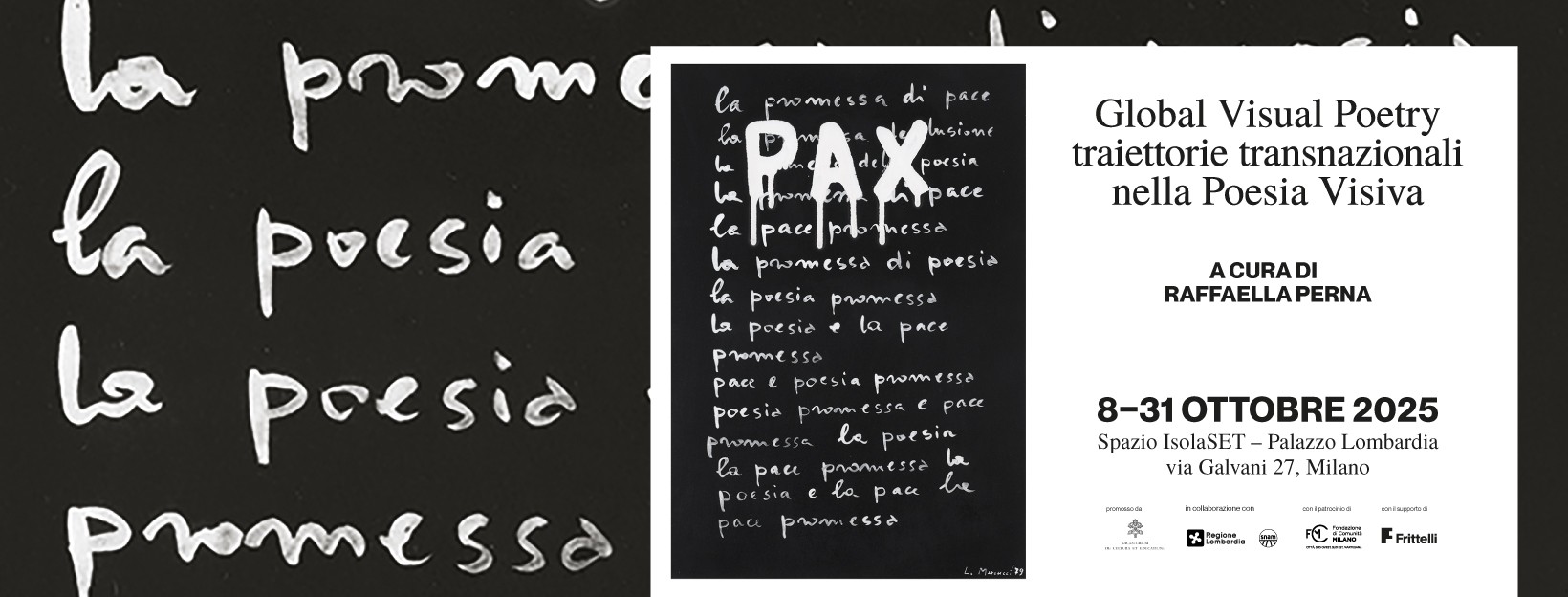
Global Visual Poetry Exhibition from Rome to Milan
Spazio IsolaSET / Palazzo Lombardia
Global Visual Poetry: transnational pathways in Visual Poetry
Palazzo Lombardia - IsolaSET
curated by Raffaella Perna
Palazzo Lombardia – IsolaSET in Milan will host, from 7 to 31 October, the exhibition Global Visual Poetry: Transnational pathways in Visual Poetry, organised by the Dicastery for Culture and Education of the Holy See, in collaboration with Regione Lombardia, with the support of Snam and under the patronage of Fondazione di Comunità di Milano.
The exhibition, which is free to enter, is organised by the Jubilee Committee for Culture and Education and produced with the technical support of the Frittelli Contemporary Art Gallery in Florence.
Visual Poetry
This exhibition, curated by Raffaella Perna, aims to highlight the innovative and contemporary nature of one of the most influential movements in late 20th-century art, emphasising the strong ethical dimension of an artistic approach that has passionately engaged with the pressing issues facing people today. Through its survey of significant works of visual poetry, the exhibition thus brings to the public sphere human themes of paramount importance, such as the dignity of the person, the role of language in shaping social ethos, the quest for peace, the complex yet possible weaving of dialogue, the celebration of both personal journeys and community cohesion, and the opening up of horizons of hope and meaning.
With around two hundred works on display, the exhibition offers a cross-sectional view of the various verbal-visual experiments that emerged in the post-war period, in Italy and abroad — from Concrete Poetry to Visual Poetry and New Writing — with the aim of highlighting the affinity and coherence of vision among artists working in different geographical contexts, yet united by a strong critical stance towards contemporary reality. By highlighting the crucial role of Visual Poetry in the debate on the social and cultural effects produced by consumer society and the economic boom, the exhibition aims to bring to the fore, at least in embryonic form, a poetics of human redemption that combines the symbolic tools of word and image in the creation of new spaces of expressive freedom and in the development of personal and collective imaginaries that are neither mass-produced nor standardised, open to the mystery of the subject and its revelation in the word.
Themes explored
Particularly significant is the way in which, since the 1950s and 1960s, visual poets have adopted a critical stance towards the excesses of capitalism, choosing to use alternative languages, humble materials and non-elitist practices to create art capable of listening to everyday life and its deepest needs.
At the heart of Visual Poetry lie highly topical themes: concern for the environment and ecological issues, the status of women, criticism of anti-democratic tendencies, pacifist demands, interest in the economic and social imbalances produced by modernisation, attention to the human word and the rejection of its degradation to a mere means of communication, whilst highlighting its poetic potential. These are themes that not only confirm the political and social commitment of this movement, but also contribute to the renewed critical interest that Visual Poetry is currently experiencing on an international level.
A transnational movement
The exhibition curator recalls: «In 1965, the German philosopher Max Bense wrote that concrete poetry “does not separate languages, but unites them, blends them”. This statement is more relevant and significant today than ever before: from the very beginning, in fact, verbal-visual poetics have enjoyed widespread and international dissemination, involving authors active in geographically distant regions such as Brazil, Argentina, the United States, Germany, France, Italy, Switzerland, Portugal, Czechoslovakia and Japan. In an era marked by the consolidation of global communication networks and the expansion of the mass media, Visual Poetry has become a vehicle for intercultural exchange, an instrument of symbolic resistance and a shared ground for experimentation, transcending national borders».
Starting from the local realities of their countries of origin, many artists involved in this research have been able to look beyond national borders, addressing issues that have become global in scope, such as war or conditions of poverty in the so-called ‘Global South’.
A hybrid language
The exhibition captures the complexity and richness of a verbal-visual universe that has transcended the traditional disciplinary boundaries between poetry, the visual arts, graphic design and communication, through the adoption of a hybrid language in which the word becomes image, body, sound and space.
This drive towards linguistic experimentation and the urgency to deconstruct the traditional codes of mass media communication represent one of the defining features of Visual Poetry, a movement that has combined conceptual rigour with an openness towards popular imagery.
The exhibition
In this exhibition, this artistic calling emerges with all its force: the approximately 200 works on display, often small in scale and created using simple means, are the result of an artistic practice dedicated to lightness, widespread dissemination and the democratisation of the aesthetic experience.
The exhibition Global Visual Poetry aims to document an artistic period which continues to interrogate our present through the contemporary nature of verbal-visual language.
In the exhibition itinerary, designed for the IsolaSET venue, ample space is given to the work of artists born or active in Milan. This is the case with Emilio Villa, a writer, philologist, art critic and visual poet born in Affori in 1914, one of the most radical and original voices in late 20th-century literature. Central to his writing are his Lombard origins and the use of dialect, elements that contribute to his search for a poetic word capable of transcending the boundaries of language and sign. Also featured in the exhibition is Ugo Carrega: it was he who, in 1971, founded the Centro Tool at Via Borgonuovo 20, a space dedicated to avant-garde artistic and literary research, which in 1974 became the "Mercato del Sale", an experimental cultural centre active until 1990.
It was at the Centro Tool in Milan, in January 1972, that the International Exhibition of Visual Artists was held – the first exhibition entirely dedicated to female visual artists – curated by Mirella Bentivoglio, an artist and curator whose work is featured in the exhibition. Giancarlo Pavanello and Emilio Isgrò have also been working in Milan for decades.
Artists featured in the exhibition:
Vincenzo Accame, Vincenzo Agnetti, Ruth Aklander, Elvira Alfageme, Alain Arias-Misson, Carlo Belloli, Mirella Bentivoglio, Tomaso Binga, Julien Blaine, Achille Bonito Oliva, Jean François Bory, George Brecht, Joan Brossa, John Cage, Julio Campal, Ugo Carrega, Luciano Caruso, Giuseppe Chiari, Henri Chopin, Herman Damen, Betty Danon, Augusto De Campos, Vicente De Percia, Álvaro De Sá, Paul De Vree, Stanislaw Dróżdż, Jean Dupuy, Pablo Echaurren, Anna Esposito, Amelia Etlinger, Heinz Gappmayr, Klaus Groh, Elisabetta Gut, Graciela Gutierrez Marx, Bernard Heidsieck, Dom Sylvester Houédard, Emilio Isgrò, Motoyuki Ito, Ernst Jandl, Hiroo Kamimura, Katué Kitasono, Etsushi Kiyohara, Annalies Klophaus, Milan Knížák, Jiří Kocman, Jiří Kolář, Maria Lai, Liliana Landi, Maurice Lemaître, Claudio Locatelli, Arrigo Lora Totino, Roberto Malquori, Lucia Marcucci, Stelio Maria Martini, Dóra Maurer, Hansjörg Mayer, Eugenio Miccini, Fernando Millán, Magdalo Mussio, Giulia Niccolai, Seiichi Nikuni, Anna Oberto, Martino Oberto, Luciano Ori, Claudio Parmiggiani, Giancarlo Pavanello, Rudolf Pawell, Michele Perfetti, Michael Joseph Phillips, Décio Pignatari, Lamberto Pignotti, Marko Pogacnik, Roland Sabatier, Sarenco, Alain Satié, Greta Schödl, Toshihiko Shimizu, Berty Skuber, Mary Ellen Solt, Adriano Spatola, Chima Sunada, Luigi Tola, Endre Tót, Timm Ulrichs, Franco Vaccari, Emilio Villa, Rodolfo Vitone, Simona Weller, Syoji Yoshizawa, Franci Zagoričnik.
The catalogue
The exhibition is accompanied by the publication of a catalogue in Italian and English, published by Società Editrice Allemandi, featuring texts by Cardinal José Tolentino de Mendonça and the curator, Professor Raffaella Perna.