

Giro d’Italia, the Pope to the cyclists: "You are role models for young people across the world"
Leo XIV greets cyclists passing through Vatican City State, inviting them to take care of ‘the whole human being: body, mind, heart and spirit’. He shakes hands with the Maglia Rosa, Simon Yates, who in turn leads his teammates on a three-kilometre journey through the Gardens, the Grotto of Our Lady of Lourdes and the Mater Ecclesiae monastery. This event also commemorates Pope Francis, who had embraced the initiative proposed by Cardinal José Tolentino de Mendonça, Prefect of the Dicastery for Culture and Education, and implemented in cooperation with the Governorate of Vatican City State and Athletica Vaticana.
Edoardo Giribaldi | Vatican News
One of the most famous photographs in cycling history captures Fausto Coppi and Gino Bartali, champions and rivals, passing a water bottle to each other. That simple gesture has become an icon of humanity that recognises itself even in competition: a silent pact between professionals. Clearly, these are not rivals, but an echo of that brotherhood can be felt today, Sunday June 1, around 3.30 p.m., in the heart of the Vatican City State, when Pope Leo XIV greets the cyclists of the Giro d'Italia, welcoming them as “role models for young people across the world”.
A ‘passing of the baton,’ one might say, for an initiative - a ‘non-competitive’ passage - initially embraced by Pope Francis, as suggested by Cardinal José Tolentino de Mendonça, Prefect of the Dicastery for Culture and Education, and carried out in synergy with the Governorate of Vatican City State and Athletica Vaticana.

The Pope's greeting
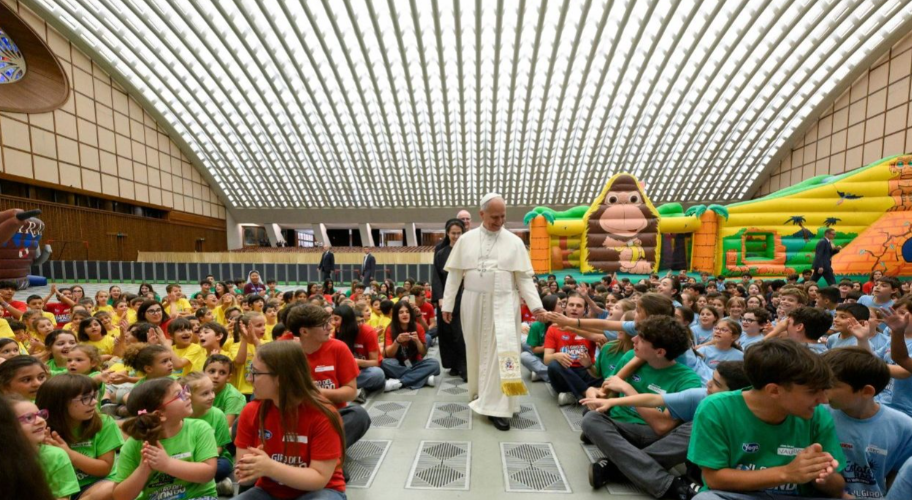
The most eagerly awaited encounter is the one that takes place in Piazza dei Protomartiri: between the cyclists and the Pontiff. The pace is calm, the route free from competition pressure. No sprinting, no chasing: it is a reversed race, where the winner is whoever manages to catch the gaze and blessing gesture of Leo XIV. Urbano Cairo, owner of RCS, Paolo Bellino, general manager of RCS Sport, and race director Mauro Vegni give the Maglia Rosa, the jersey awarded to the winner of the Giro d’Italia, to the Pope, in the presence of Sr. Raffaella Petrini, president of the Governorate of Vatican City State. Then the real Maglia Rosa, Simon Yates, shakes hands with Leo XIV, followed by the other winners: the Maglia Ciclamino, for the best placement in the points classification, Mads Pedersen; the maglia bianca, for the best young rider, Isaac Del Toro; and the maglia azzurra, for the best climber, Lorenzo Fortunato.
‘Good morning, everyone! Welcome to the Vatican City State!’ begins the Pontiff, who wishes all the cyclists a ‘wonderful day’.
‘Be aware that you are role models for young people all over the world. The Giro d'Italia is truly loved, and not only in Italy. Cycling, like any sport, is very important,’ emphasises Leo XIV, addressing the athletes directly:
‘I hope as you have learned to care for the body, the spirit is blessed too, and that you are always careful of the whole human being: body, mind, heart and spirit.’
Then, a few words in English, his mother tongue, to remind everyone that they are always welcome, both in the Vatican City State and in the Church, ‘which represents God's love for all people’. Amid smiles and signs of the cross, the Pope symbolically accompanies the cyclists, encouraging them with the silent strength of his presence.
The stages of the route in Vatican City
The final stage of the 108th edition of the Giro d’Italia is not just about sport: it is a pilgrimage on two wheels. More than competitiveness, it relies on symbolism. This year, it pays tribute to Pope Francis, in the year of the Jubilee, which continues to draw thousands of religious people — and now also cyclists — from all over the world. The route within the Vatican walls spans approximately three kilometres through history and silence, stone and breath, passing through the Gardens and riding alongside the Grotto of Our Lady of Lourdes, Saint John’s Tower and the Vatican Heliport. From there, it continues through Mater Ecclesiae monastery, going past the railway station. A spiritual journey through the images of the Mother of God - inaugurated by the mosaic of Our Lady of Good Counsel, tied to Augustinian tradition held so dear by Leo XIV - venerated as patron saints in different corners of the planet, symbolising the multi-ethnicity that is also characteristic of the Giro d’Italia: 159 cyclists from 29 countries. The cyclists return to Santa Marta Square and the Perugino Gate, from where they leave the Vatican City State for the official beginning of the stage.
The connection between Popes and cyclism
The link between Pope Leo XIV and sport has already been revealed in significant images: his meeting with tennis player Jannik Sinner and with the Naples team, winners of the Serie A football championship. However, cycling is where the story's oldest threads intertwine. Since June 26 1946, when Pope Pius XII welcomed the cyclists of the Giro d'Italia to the Courtyard of San Damaso before the start of the ninth stage from Rome to Perugia (191 km), this sport has found a home in the Vatican City State. Curiously, it was Gino Bartali who triumphed on that occasion. Pius XII, Paul VI, John Paul II: many Popes have crossed paths with the Giro d’Italia on the roads of faith and hope. We should also remember the words of the Patriarch of Venice, Albino Luciani, who on May 20 1972 — six years before becoming Pope John Paul I — said: ‘If all sport is human, for us Italians the Giro d'Italia is very human indeed’.
A brief history of cycling in the Vatican City State
There is a history imbued with the spiritual soul of a people that will accompany the athletes of the Giro d'Italia – and the entire world of cycling and sport – as they cycle along the roads of the Vatican City State Gardens.
On June 26 1946, Pope Pius XII held an Audience with the cyclists participating in the Giro d'Italia in the San Damaso Courtyard in the Vatican City State. This was before the start of the ninth stage from Rome to Perugia (191 km). That Giro d’Italia (the 29th edition) was won by Gino Bartali and the stage by Aldo Baito (with Vito Ortelli in the maglia rosa). At the end of the audience, the cyclists – and the entire Giro d’Italia “caravan” – left the Vatican City State (by car and bicycle) via the Arco delle Campane and across St Peter's Square.
On 14 June 1950, Pope Pacelli received the cyclists participating in the 33rd edition of the Giro d'Italia at a general audience in St Peter's Basilica. The race had ended the previous day in Rome with Oreste Conte winning the stage (230 km, starting from Naples) and Hugo Koblet achieving the overall victory.
On Saturday 30 May 1964, Pope Paul VI received the participants in the 47th edition of the Giro d'Italia in Audience at Castel Gandolfo. The day before, stage 14 (210 km - starting from Caserta) had arrived in Castel Gandolfo. Vittorio Adorni won the stage and Jacques Anquetil, wearing the maglia rosa, eventually won the Giro d'Italia. On Saturday 30 May, the cyclists set off from Rome to arrive in Montepulciano (214 km – won by Nino Deflippis).
‘If all sport is human, for us Italians the Giro d'Italia is very human indeed’: with these words, on 20 May 1972, the Patriarch of Venice, Albino Luciani (elected Pope in 1978 under the name John Paul I), symbolically opened the 55th edition of the Giro d'Italia, which started the following day. The Venice-Ravenna stage (196 km) was won by Marino Basso and the final classification by Eddy Merckx.
On 4 July 1973, in Santa Marta Square in the Vatican City State, Paul VI blessed the monument in front of the Sanctuary of Our Lady of Ghisallo, proclaimed patron saint of cyclists by Pius XII (13 October 1949). On several occasions, John Paul II, Benedict XVI and Francis have supported the sporting spirituality of the sanctuary.
On Thursday, 16 May 1974, Pope Paul VI welcomed the cyclists participating in the 57th edition of the Giro d'Italia in the San Damaso Courtyard in the Vatican City State. On that occasion, the Pope symbolically gave the “start” signal and the cyclists left the Vatican City State through the Arco delle Campane and crossed St Peter's Square after travelling along Via delle Fondamenta. The stage (the first of that Giro d’Italia) ended in Formia (164 km): victory went to Belgian Wilfried Reybrouck, with Eddy Merckx winning the overall classification.
On Friday May 12 2000, Holy Year, Pope John Paul II held an Audience with the cyclists participating in the 83rd edition of the Giro d'Italia in the Sala Clementina of the Apostolic Palace in the Vatican City State. The day before the starting stage, which took place with a time trial in Rome (4.600 km - won by Jan Hruška, an athlete from the Czech Republic). In the final classification there was Stefano Garzelli in the maglia rosa.
Source: Vatican News