
Polvani: AI will bring upheavals on scale comparable to Industrial Revolution
The Secretary of the Dicastery for Culture and Education reflects on the impact of new technologies, the central theme of the AI Action Summit scheduled to take place in Paris. He emphasises the need to define objectives that place human beings at the centre of technological progress. The note Antiqua et Nova is a warning to the global community to seize the opportunities offered by innovation, while always maintaining control over machines.
Vatican News / Delphine Allaire - Vatican City
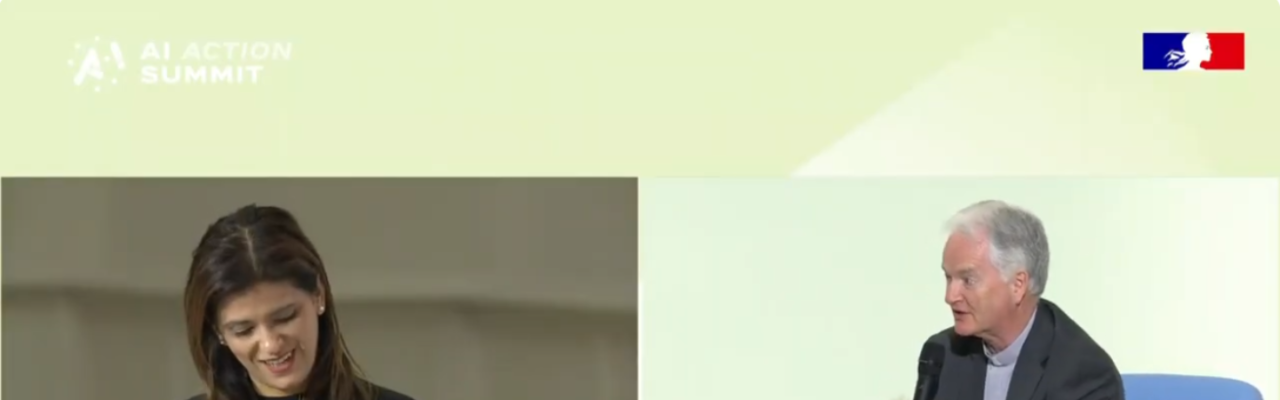
A ‘historic moment’, a proper ‘revolution’ comparable to the industrial revolution of the 19th century. An epochal change in which the Church proposes itself as an active interlocutor, with the aim of keeping human beings at the centre and using new technologies to spread the Word of God in innovative ways. This is the perspective outlined by Monsignor Carlo Maria Polvani, secretary of the Dicastery for Culture and Education, regarding the use of Artificial Intelligence, which is the focus of AI Action Summit, bringing together influential figures from the sector on February 10 and 11 in Paris. Co-chaired with India, the international meeting gathers over a thousand people from the private sector and civil society to establish the foundations of global AI governance. Archbishop Carlo Maria Polvani, one of the authors of Antiqua et Nova, shares key insights from the document, highlighting the major existential and anthropological stakes of this tool.
How would you define the scale of the AI revolution, and why is it necessary for the Holy See to address it?
When Machiavelli wrote The Prince, Erasmus was developing humanism, Europe was discovering America, and the Spanish and Portuguese were reaching the Indies. The question is: do societies living through a historic moment realize it? We are in the midst of such a moment.
We can understand what AI will do to our planet and to humanity by drawing an analogy with the Industrial Revolution that began around 1800. We are witnessing massive transformations, comparable to the sociological and anthropological upheavals of the Industrial Revolution. The magnitude, however, is harder to predict—will it be ten times, a hundred times, or a thousand times greater? With AI and NBIC – nanotechnology, biotechnology, information technology and cognitive science – the most extreme position is to think that humanity is becoming the first species on this planet to become master of its own destiny from an evolutionary point of view. Reasonably, we will not be able to say this for more than fifty years. But we can expect changes of a very large order of magnitude.
What role should the Church play in this dizzying context? What was the intent behind writing Antiqua et Nova?
The Church cannot remain silent in the face of such a profound phenomenon. First and foremost, AI should neither be demonized nor idealized. We must recognize its dangers but also its benefits for humanity. We should neither fall into despair, believing that a disastrous end for humanity is imminent, nor succumb to excessive enthusiasm, thinking that the human race will completely transform. Instead, we must analyze the phenomenon.
A striking example of AI’s dual nature: the Cochin Hospital in Paris uses AI to detect breast cancer, saving an incredible number of lives. But we can also imagine a scenario where AI is used to determine which patients receive treatment first, without human or medical oversight. The Church emphasizes the centrality of the human person and special care for the most vulnerable. We must ensure that AI does not exacerbate inequalities.
Unfortunately, the Industrial Revolution—which we referenced earlier—did raise overall living standards but also led to serious negative consequences. The revolution was not well regulated, and the same risk exists for AI. If we fail to regulate it properly, we will face significant dangers. Political, anthropological, philosophical, and scientific choices must be made now to limit these risks—the greatest of which, as the Pope has repeatedly warned, is depriving humans of their dignity to choose and determine their own fate.
How should we respond to AI’s temptation to make humans believe they are their own creators, sometimes even rivaling the divine plan?
The first part of Antiqua et Nova places AI within the historical context of rationality and intelligence in classical philosophy and anthropology. There are multiple forms of intelligence. Today, we scientifically understand that emotional intelligence is distinct from intellectual intelligence. Without this analysis, there is a risk of seeing AI as a solution for everything, which is not the case. AI must remain confined to objectives set by humans. The real danger arises when humanity loses control over AI’s goals and applications.
How will the relationship between humans and machines evolve, and how does this challenge Christian anthropology?
In the 1940s—nearly a century ago—Georges Bernanos wrote in Revolution and Liberty that the real problem is not the increasing number of machines but the growing number of people who desire only what machines can provide. Technology itself is not the issue; rather, it depends on how humans interpret and use it.
The additional challenge with AI compared to previous technologies like television or radio is that AI operates autonomously. Unlike a TV or radio that requires human intervention to turn on or off, AI continues functioning once programmed to solve a problem. Moreover, it becomes increasingly effective as it accumulates more data. This means that AI can, in some ways, develop an independent existence beyond human will.
What are the spiritual dangers of AI? Could it alter our relationship with God, the Word made flesh?
AI has the potential to reshape anthropology—the way we understand ourselves as Christians and, specifically, as Catholics. Catholicism distinguishes itself from other Christian traditions by viewing nature as a vessel for grace.
There is never a contradiction between grace and nature in Catholic theology, except in the case of sin. If AI alters our understanding of human nature, it could also affect our understanding of grace and the relationship between grace and nature. These are classical theological concepts, rooted in Aristotle and Saint Thomas Aquinas. However, neither Aristotle nor Aquinas could have imagined a machine so advanced that it might lead humans to believe they are fundamentally different beings.
How can AI be linked to hope in this Jubilee Year? Can its use help us become better?
AI is one of the most complex challenges humanity will face in the future. However, we must have hope that humans will rise to meet these challenges. The Pope believes this. The Church believes this. We must not despair—this is an extraordinary opportunity. AI has the potential to do tremendous good. Certainly, mistakes will be made—humanity has always made mistakes—but this does not mean we should succumb to apocalyptic thinking. Hope provides us with the inner peace to believe that, in the end, humanity will triumph and use this tool wisely.
What is AI’s rightful place in our civilization?
AI offers remarkable opportunities to make people better. Instead of increasing social inequalities, it could be an incredible tool to reduce them. In education, for example, AI could be used in extraordinary ways—but also in harmful ways. One positive aspect is that AI can democratize knowledge. Around the world, even people without access to libraries can now obtain vast amounts of information. For this reason, Christians must actively engage with AI to ensure that it represents diverse knowledge and cultures. The Pope has emphasized this, particularly regarding Indigenous peoples. If AI had existed 500 years ago, we could have preserved Indigenous languages in Mexico, Brazil, and the Amazon. AI holds exceptional potential for good, even from a cultural perspective.
How might the Holy See use artificial intelligence within its institutions?
The Catholic Church, with its centralized structures, possesses an extraordinary wealth of data. AI could enhance efficiency in many areas, from statistical analysis to pastoral outreach. It could help reach remote communities where travel is difficult, making catechesis more accessible.
AI can facilitate the spread of the Word of God, making evangelization easier.
Source: Vatican News